News
Browse Senn Group’s latest news, updates and papers.
-
Symmetry-adapted pair distribution function analysis (SAPA): a novel approach to evaluating lattice dynamics and local distortions from total scattering data

A novel symmetry-adapted pair distribution function analysis (SAPA) method for extracting information on local distortions from pair distribution function data is introduced.
-
In Situ X-ray Diffraction Investigation of Electric Field-Induced Switching in a Hybrid Improper Ferroelectric

Improper ferroelectric materials are increasingly under investigation for their potential to expand the catalogue of functional ferroelectrics and couple with properties such as ferromagnetism.
-
From first- to second-order phase transitions in hybrid improper ferroelectrics through entropy stabilization
Hybrid improper ferroelectrics (HIFs) have been studied intensively over the past few years to gain an understanding of their temperature-induced phase transitions and ferroelectric switching pathways.
-
Anharmonicity and scissoring modes in the negative thermal expansion materials ScF3 and CaZrF6
We use a symmetry-motivated approach to analysing X-ray pair distribution functions to study the mechanism of negative thermal expansion in two ReO3-like compounds; ScF3 and CaZrF6.
-
Tolerance Factor Control of Uniaxial Negative Thermal Expansion in a Layered Perovskite
By tuning the tolerance factor, t, of the Ruddlesden–Popper oxide Ca2MnO4 through isovalent substitutions, we show that the uniaxial coefficient of linear thermal expansion (CLTE) of these systems can be systematically changed through large negative to positive values.
-
Now Recruiting: 3 year EPSRC funded PDRA in the Crystallography of Multiferroic Materials
A three year PDRA on the Crystallography of multiferroic materials is available within the group.
-
EPSRC New Investigator Grant Awarded
The group has been awarded a three year, £380k EPSRC grant on ““Novel Multiferroics Perovskites through Systematic Design”. As part of this grant we will be recruiting a Postdoctoral research fellow for a three year post that will focus on the crystallography of multiferroic materials. What this space for more details!
-
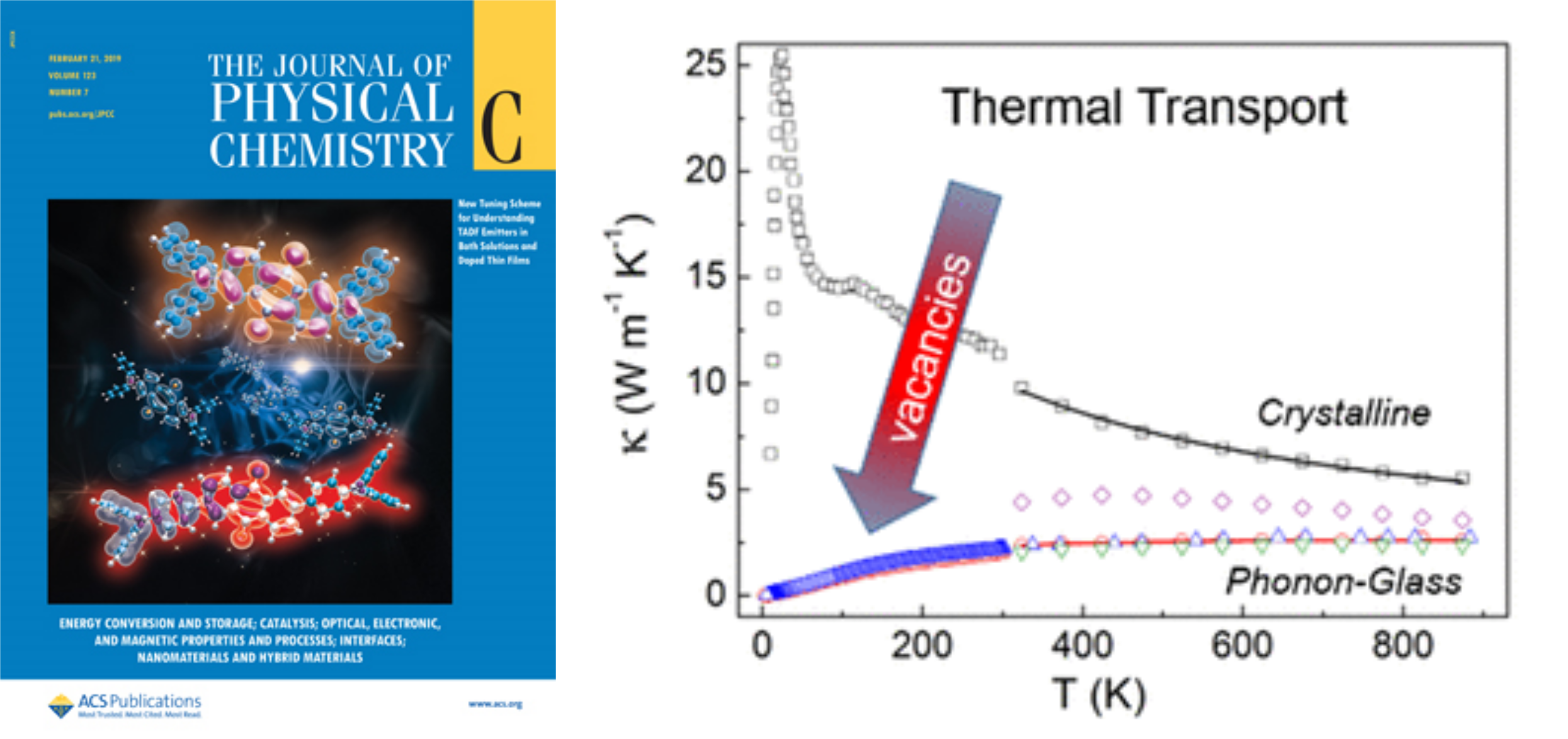
Phonon–Glass and Heterogeneous Electrical Transport in A-Site-Deficient SrTiO3
The phonon–glass electron crystal concept is one of the key guiding principles for the development of efficient thermoelectric materials.
-
Negative thermal expansion in high pressure layered perovskite Ca2GeO4
We report the high pressure synthesis of a layered perovskite Ca2GeO4 which is found to have the Ruddlesden–Popper structure with I41/acd symmetry.